
Look! Romans! or - Ecce Romani in 1971!
- Nov 28, 2025
- 8 min read
Updated: Dec 2, 2025
This blog is an extract and commentary on a review of the first edition of the Latin course book Ecce Romani. It was first published in the ARLT’s journal Latin Teaching XXXIII, 6, p 224 in 1971. The reviewer WSW (I have been unable to ascertain their name) refers to two books in their review.

Like the one I have blogged about before from this same journal, I think WSW's review sheds some light on pedagogical thinking of the time and can also be useful for reflecting about current practices.
Here goes:
Ecce Romani: Meeting the Family. Scottish Classics Group. Olive & Boyd. 25p.
The first volumes have appeared of two series full of the greatest promise: and by coincidence the name of Dr Kilgour, who is well known to many members of the A.R.L.T. is associated with both of them. He is one of the group responsible for the former and is thanked for “general assistance and encouragement” by the compiler of the latter. Both books are single fascicules stapled: they contain 58 and 62 pages respectively and pp. 20-24 of Ecce Romani to some extent overlap the matter of the other book. […..]
“Meeting the Family”, first part of a “reading-orientated presentation of Latin” in six volumes, has an attractive cover showing a lararium […] and its title is in charming capitals – Carolingian perhaps rather than Trajanic. Nine full page drawings illustrate the adventures of the family we are to meet; the equivalent of about three more pages goes on maps, plans and antiquities; the last glare to Dr. Bullock-Davies‘s article on another page of this number. I have not been able to relate the picture on p. 47 to the text; somewhere about p. 11 looks the most likely: the reasons why it could not have gone there are apparent. The drawings are about the best I have seen in a Latin textbook - not perhaps the highest of praise - but opposite p. 44 there is one that seems not only sound pedagogically but also in the highest class of book illustration.
There are fourteen chapters: a short passage of narrative or description is followed by one to four exercises - responde Latine, language manipulation by alternative or multiple choice (and translate) and revision translation last. Between chapters 6 and 7, 7 and 8 and 9 and 10 come background sections. Tabulation of the grammar of noun and adjective is inserted between “Dress” and “The Slave-market”. Neuter nouns are saved up until chapter 13. By chapter 10 Masculine and Feminine of [the] first three declensions have been dealt with in both numbers and all cases except the dative. We have had infinitives as early as 5, perfect participle passive in 12 without any tabulation or explanation of course. Of finite verbs not ending in -t sum entered in 4, venio not until 13, video and vis in 14: tabulation of three persons in two numbers makes the climax of the book: palcet for placet p. 56 was the only misprint I noticed.
The reading matter is genuinely interesting and the language has a vigour, a real feel of Latinity one might almost say “style” which is quite remarkable within the straitjacket of “carefully controlled input of forms &c.” Responde Latine and language manipulation ensures that we are not learning a “dead” language; background “grows naturally out of the reading passages and is intended to stimulate finding out”. Teachers [sic] handbooks have not yet been received. Most of the quotations in this review from the publishers’ description. They also seem fully substantiated from the book. If the standard of “Meeting the Family” can be maintained, this course will be quite outstanding among modern Latin courses. It has been “tested over two years in a total of 48 schools” and seems likely to prove just the kind of course on which Latin Prose Composition could be built without sentences &c. at the early stages. W.S.W.
I don’t know about you, but I love reading these reports from the past on Latin pedagogical thinking. These are the things that interest me about this review of Ecce Romani (which, incidentally, is still used in a small number of schools, even though it has barely been updated since the 1980s. If, for old time’s sake, you want a first edition, there is one available on a well-known book seller’s website for around £39.00. Rather a mark-up from the original 25p.
Here goes:
1. …has an attractive cover showing a lararium… The reviewer genuinely thought this was an attractive feature. Which just goes to show how terrible Latin books looked prior to this publication must have been and how much better they look now.
2. Nine full page drawings illustrate the adventures of the family we are to meet. Again, a real novelty for the time. But Ecce Romani was perhaps the first to see that integrating the illustrations with the Latin story significantly aided the development of language learning. This, I feel, still remains elusive in some courses today, where the student gains little assistance in learning the language than lists of vocabulary and tables of inflections. Now, of course, the teacher is there to remind, promote and guide. But realistically, the picture – provided that it is tied in with the text in an obvious way – can do some of that job as well, especially if the teacher is not near at hand. look at the picture below, for example. Did you immediately spot the boy in the tree?
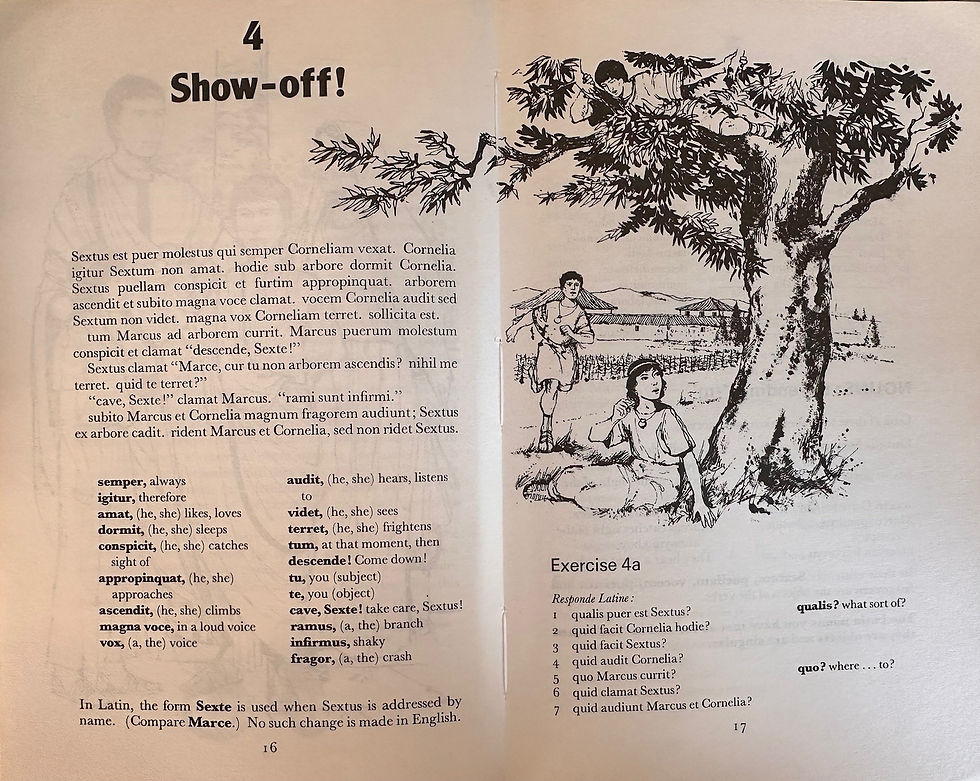
3. The drawings are about the best I have seen in a Latin textbook - not perhaps the highest of praise - but opposite p. 44 there is one that seems not only sound pedagogically but also in the highest class of book illustration. Sadly, I have not got a copy of the 1st edition to hand, so I do not know which picture the reviewer is admiring. However, they make the point that quality matters – the look of the image is important not just for historical and narrative accuracy but also because it draws the student in (the authors have taken the trouble to make a nice book). The other point the reviewer makes is that the illustration is ‘sound pedagogically’. By that, I think they mean that the picture fits the text – it really is an aid to understanding the text and developing the student’s capacity to deal with the meaning of the text. A thing I find constantly amusing (not in a good way) is how so few teachers seem even to notice the illustrations in reading courses. It’s almost as if a ‘true Classics teacher’ has no need of pictures to understand what the Latin says. Well, of course, that may be the case for those of us who have been in the game for a long time. But for the student who has been taking Latin for only a few months or even a year or so, the pictures – if they are good ones – can be an important support. One can use them at the start of the lesson to anticipate what happens in the narrative; refer to the picture as the narrative unfolds, and go back to the picture at the end. Simple stuff – but, sadly, rarely done.
Think how you, as teacher, might help students anticipate the story line by looking at the picture before attempting to understand the meaning of the Latin text. What vocabulary in English might you allude to in order to hint at when you all get to the tricky bits? Climb? Branch? Fall?
4. There are fourteen chapters: a short passage of narrative or description is followed by one to four exercises - responde Latine, language manipulation by alternative or multiple choice (and translate) and revision translation last. The pattern is familiar now to anyone who uses an inductive reading course like Ecce or Cambridge or Suburani. It must have been groundbreaking at the time. “But how could students translate a passage of Latin which they have never seen before, with new vocabulary and new grammar?” I am sure the authors heard that then – and we still hear it now. The trick is that the story is NOT A TRANSLATION. It’s a conversation piece – a starting point, not an end in itself. Let’s go back to that review of the ARLT summer school in which Mr. Thorpe demonstrated the Cambridge Latin Course. Read aloud; ask who / what / where / when / why? questions; ask inwardly; ask outward. This is reading together with the class as a whole, and for gist and clarification. It’s not a test – it’s a learn. Note, the reviewer points out the sequence of activities – responde Latine, language manipulation, translation. It’s a carefully worked-out sequence which has to be kept to. no missing out of the stages. Carefully plotted, the student moves from gist, to clarification, to practice. The vocabulary for each activity derives from the first story in each chapter. Then there’s repetition of individual words and phrases, by seeing them on the page and by hearing and by saying them in the classroom. Next, the student meets them again through elaboration of sentences; and finally, there’s controlled output where the student selects the correct form of word to complete the sense of the sentence.

5. Tabulation of the grammar of noun and adjective is inserted between “Dress” and “The Slave-market”. It is interesting that the reviewer seems to take reassurance that there are tabulated forms in the book. They mention two of the slices of background material. “Dress” is of little interest here. “The Slave-Market” would deserve some closer scrutiny today. A decent teacher might have interrogated some of the assumptions made in the text. I wonder how many did?

6. It has been “tested over two years in a total of 48 schools” and seems likely to prove just the kind of course on which Latin Prose Composition could be built without sentences &c. at the early stages. The reviewer notes with approval the fact that the course book has received extensive testing. Would that some modern course books have been trialled as much. I’m not sure whether the authors of Ecce Romani would have been in agreement with the reviewer about their course book’s potential for supporting Latin Prose Composition. If anything, the methodology would barely align with it. Such questions continue to arise even today where teachers mix and match language teaching methodologies.
I am informed (2nd December 2025) that Ecce Romani! is still going strong in classrooms in North America. Now in its 4th edition, you can find out more here.


Mình chơi xổ số kiểu cho vui là chính, coi như giải trí sau giờ làm nên chuyện trúng hay không mình không đặt nặng. Trước đây nghe bạn bè bàn về đủ loại “cầu kèo” này nọ, mình cũng tò mò nhưng vẫn nghi ngờ. Theo dõi một thời gian thì đúng là có vài dạng số hay lặp khiến mình chú ý, nhưng mình chỉ xem như gợi ý. Lúc đọc nhận định ở soicauxsmb.io, mình thường ghi lại vài ý ngắn rồi chờ kết quả để tự kiểm tra xem có bị cảm giác dẫn dắt không. Có hôm trúng được chút thì vui, nhưng cũng nhiều lần lệch xa nên mình nhắc bản thân đừng tin…