
Reflections from the CA Conference: Teaching, Talking and Thinking Together
Updated: Apr 22

Conferences remind us why we do this work. They gather the people who care about the same strange, brilliant things we do - language pedagogy, the ancient world, the craft of teaching - and put them in a set of rooms long enough for ideas to spark. This year’s CA conference, which was held in the spectacular Business Centre of Manchester Metropolitan University, was no exception. Here are the moments and conversations that stayed with me.
Problem‑Based Learning: When Do We Step In?
I participated in a presentation, ably delivered by Katharine Russell and Alex Kemsley, exploring problem‑based learning (PBL) and the tricky question of student dependency. How much guidance is too much? How much is too little? And what does “stepping in” actually look like?
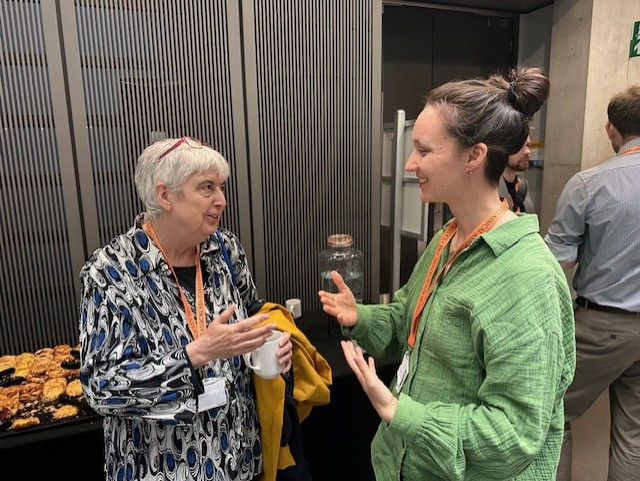
We wrestled with the difference between project‑based and problem‑based approaches. Rather than assigning a task about the ancient world, PBL uses the ancient world to help illuminate a modern problem. It’s a subtle but important shift. The danger, of course, is drifting too far from antiquity until the activity becomes free‑floating discussion rather than focused on the evidence from the ancient world.
PBL sits awkwardly within the current educational zeitgeist. Child‑centred learning is being loudly dismissed in some quarters - Nick Gibb’s critiques being the most visible for some time - and in some schools group work is treated with deep suspicion. One local Cambridge school, for example, prohibits group work across its entire Multi Academy Trust – and it is not unusual in so doing. In such climates, PBL can feel like swimming against the tide.
What I valued most about this panel was that we didn’t simply receive a framework, but rather we worked it out together. We were both teachers and students, grappling with the same intellectual challenge. Anxiety about AI surfaced repeatedly, though not always clearly articulated: was the concern cognitive offloading, hallucination, ethics, or simply the pace of change? Probably all of the above.
New Teachers, New Approaches
A panel of early‑career teachers offered a refreshing, grounded look at classroom practice.
It was a pleasure to reconnect with Vlada Oulitskaia, whose school uses a language carousel before students choose a language for Year 9 and then again for GCSE. The risk of losing students at each transition is real. Her emphasis on maintaining engagement and basic linguistic competence, so that each “fresh start” feels like a continuation rather than a reset, felt exactly right. But the challenge is real. I know of other schools which offer similar carousels – it might be worth finding out a little more about what works, and what doesn’t.

Ashleigh Chhibber from Riddlesdown Collegiate (a school in Purley, South London, to which I have sent several of my PGCE students over the years) spoke with engaging clarity about vocabulary retention, teaching intentionality and classroom modelling. He is thinking hard about what he wants students to really know and be able to do, and how explicit instruction can support that. He's realistic and decisive. He moves next to a central London non‑selective boys’ school to start Latin there. They will be lucky to have him.
Speaking Latin: Input, Prosody, and Practice
A highlight was the panel on spoken Latin with Lisa Hay, Mair Lloyd (both Cambridge School Classics Project), and Professor Christian Laes (Manchester).
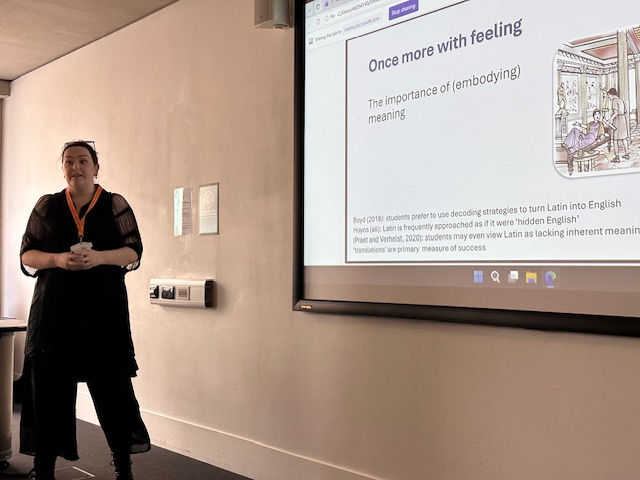
Lisa emphasised the importance of subvocalisation, prosody, and rich input, which can take all forms: spoken, visual and gestures. These are themes close to my own work (see Teaching Latin; contexts, theories, practices), and it was heartening to hear them articulated so clearly.

Mair extended this with examples of speaking texts, that is, passages that lend themselves to oral work; and Christian added historical context, reminding us that spoken Latin has deeper roots than many assume. Much of this material is available on the Cambridge SCP website for those who want to explore further.

Conversations in the Margins
The best conference moments often happen between sessions.
I caught up with Sian Foster, president of the ARLT, with whom I’ve been working to raise the organisation’s profile. I spoke with colleagues from Classics for All, and with Jamie from CUP, who offered helpful advice on self‑publishing. A wave to Michael Sharp, commissioning editor for me and Arlene on our forthcoming Ancient Greek volume.

A long conversation with Lucy from Bloomsbury about my new book proposal, Starting to Teach Classics, was especially encouraging. The reviews are in - all but one extremely positive. My thanks to the anonymous reviewers.

And of course, the joy of reconnecting with old friends: Margaret‑Anne Gillis, Danny Pucknell, Judith Mossman, John Taylor, Sian Squire, Rosalind Aczel, Mike Beer and many others.

This is the point of conferences: to speak to as many people as possible who share your interests, all in the same room.
A Surprise from Spain
While at the conference, I received a photo from the Classica Cultura conference in Spain. Projected twenty feet high in the grand hall were images of my books. Ana Martín tells me I should expect an invitation. I will hold her to that.

Other Highlights
Professor Jo Crawley Quinn, interviewed by Catharine Fletcher, shared her work in progressive archaeology: DNA, isotopes, and the stories they unlock.
Professor Michael Wood, author of Troy and Alexander, entertained us with anecdotes from decades of historical documentary‑making.

The Classical Association Teaching Award Winners were celebrated, among them -
Tim Cooper (whom I know from my King Edward VI days) for a lifetime of service - 51 years of teaching!
Simon Beasley for innovative AI‑based teaching (I’ve invited him to my own conference on AI in October, here in Cambridge).
And the Classical Association Prize went to Arlene Holmes‑Henderson, a phenomenon in every sense.

Why We Gather
Every conference reminds me that Classics thrives not because of institutions but because of teachers, researchers and enthusiasts keep asking questions and keep showing up. This year’s CA conference was a reminder of the intellectual generosity of our field, the creativity of its teachers, and the joy of being part of a worldwide community.


Comments