
Entering the Labyrinth: Why Studying Classics Is Like Navigating a Maze

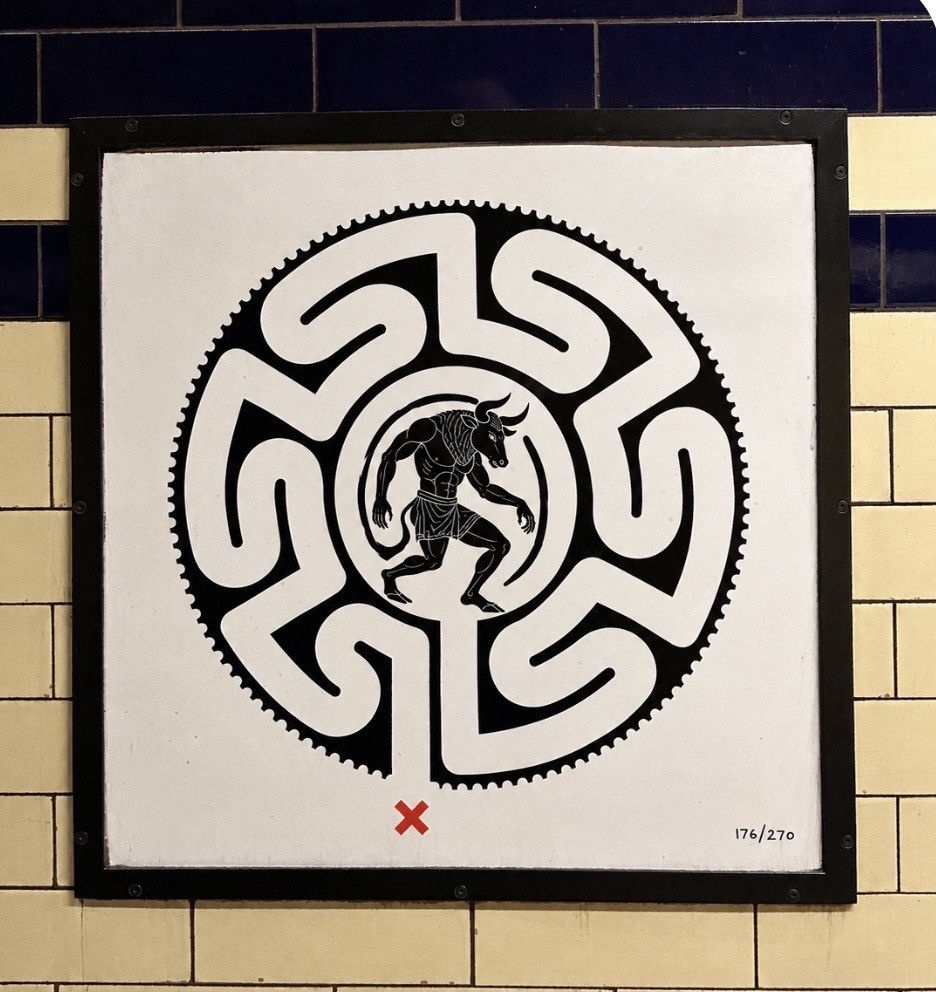
Recently, I got on at Mornington Crescent Underground Station in London, and I paused to show my daughter one of the small labyrinth plaques that now adorn every station on the Underground network. They were designed by artist Mark Wallinger (he of the London Olympics 'Cauldron') and installed to mark the 150th anniversary of the London Underground, and they depict a winding path leading towards a centre.
270 of them were originally made, one for each station; with the addition of two more stations in 2013, on the Battersea Power Station extension of the Northern Line, two more have since been added. Every one is different. The one at Mornington Crescent is number 176 out of the original 270 and is slightly hidden down at platform level in a cross passage. Most of them are more prominently displayed at ticket hall level. Perhaps the obscure setting of the one at Mornington Crescent is deliberate: part of a game to find it.
According to the TFL website, the design of a labyrinth reflects both the tunnels of the Underground itself, of course, and also the designs of the Underground Roundel and the Underground map designed by Harry Beck – a maze of a different kind. A race to visit all 270 original stations was completed in 2009 and took 16 hours, 44 minutes and 16 seconds – which seems pretty amazing. A small X marks the starting point, inviting the viewer to imagine entering the maze and beginning a journey whose destination remains unseen.
The labyrinth is one of humanity's most enduring symbols. For classicists, it immediately evokes the famous Cretan labyrinth built by Daedalus to contain the Minotaur. In Greek mythology, Theseus entered its twisting passages to confront and kill the monster lurking at its heart. The labyrinth represented danger, uncertainty, and the possibility of becoming lost forever. Yet it also represented courage, intellectual ingenuity, and the triumph of human determination over confusion and fear.
The same image later acquired new meanings in Christian thought. Medieval cathedral labyrinths, most famously that at Chartres, and also at Ely, transformed the ancient maze into a symbol of spiritual pilgrimage. The winding route was not a trap but a path of contemplation, a metaphor for the search for meaning and truth, with Christ at the centre. Unlike the classical labyrinth, whose inhabitant risked death, the Christian labyrinth offered the promise of fulfilment and enlightenment.
Standing in the Underground, I began to wonder whether the study of Classics is itself a kind of labyrinth. Students enter through many different gateways. Some begin with Latin, others through mythology, ancient history, philosophy, archaeology or literature. As they proceed, they encounter winding passages of grammar, fragments of texts, competing interpretations, archaeological mysteries and scholarly debates. There are moments of excitement and discovery, but also dead ends and wrong turns. Questions that initially seem straightforward often become more complicated the deeper one goes.
Yet perhaps this is precisely what makes Classics so rewarding. Unlike many subjects that aim to provide clear answers, Classics frequently encourages us to embrace uncertainty. The route is rarely direct. One text leads to another, one historical event opens up a wider cultural question, and one linguistic puzzle reveals further layers of complexity. Each turning offers a new perspective on the ancient world and, often, on ourselves.
So which labyrinth best represents classical study? Is it the labyrinth of Theseus, where challenges and intellectual monsters await around every corner? Or is it the Christian labyrinth, where the winding journey gradually leads towards deeper understanding? The answer may be that it is a little of both. Learning about the ancient world demands perseverance and courage, but it also offers insight, wisdom and a sense of connection with those who came before us.
Whatever the case, there is one important difference. Unlike Theseus, the Classicist is rarely trying to escape. Indeed, those who enter the labyrinth of Classics often discover that they do not really want to find their way out. The journey itself becomes the reward. And, unlike the famous game of ‘Mornington Crescent’, there is never quite a final destination. Every apparent ending opens onto another corridor, another question and another fascinating path to explore.
For many of us, that is exactly why we remain captivated by the ancient world. We enter through a small opening, expecting a short excursion, only to find ourselves happily wandering its passages for a lifetime.


Comments