
An Evening of Poetry and Statues at the Sir John Soane’s Museum
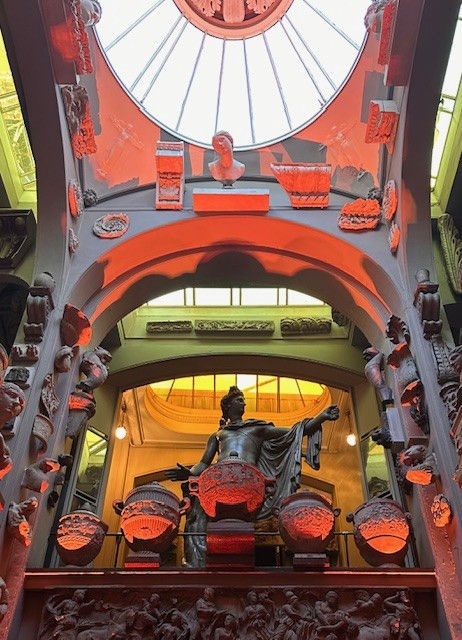
I found myself at the Sir John Soane’s Museum in Lincoln’s Inn Fields last night. I’ve been many a time since I was first shown the museum one of the tours of duty one made in the ‘Greek and Roman art and architecture’ module in my undergraduate years in Classics at King’s College, and most recently to show an architect friend round who’d never been before (how can this be, one asks?). It was an unexpected setting for an event I wouldn’t normally gravitate toward (sorry!): a Poetry and Voice Competition prizegiving, hosted by the Classical Association in partnership with the museum.
Poetry and I have an uneasy relationship. I love reading Latin and Greek poetry - the intellectual puzzle, the linguistic engineering and the pleasure of seeing how meaning is built through metre and morphology. But, just ‘poetry’, though? I’ve never quite clicked with it in the same way. Perhaps I treat classical poetry as a kind of elaborate linguistic game, whereas English poetry asks for something else – a willingness to let oneself go, perhaps. I’m not much good at that.
But when Rhiannon Litterick - once my PGCE student, now running the museum’s education services - sends an invitation, the correct response is: Come along! You’ll enjoy it! And she was right.

Descent into the Crypt
The evening began downstairs in the crypt, which was lit in a way that can only be described as “crepuscular Aperol Spritz.” Orange uplighters cast long shadows across marble limbs and ancient stone. Out of this half-darkness emerged familiar faces: children’s author Caroline Lawrence, the Hellenic Bookshop’s Monica Williams, and the University of Exeter’s own Sharon Marshall (who helped award the prizes, along with Helen Dorey, the Deputy Director of the Sir John Soane Museum, and award-winning writer Barney Norris). A small Classics reunion in a room full of creepy things (no offence intended!).

Up above us loomed the Apollo Belvedere, down below, rested in majestic bulk the sarcophagus of Seti I. How on earth did Soane get that inside his house, I wondered. Indeed, how much stuff there is in this museum – walls, ceilings, everything crammed full of statuary, architectural fragments, old and new.
New, that is, in the 18th century. And from a corner, the living mask of Sarah Siddons gazed out – once the most celebrated actress in Britain. It also ought to be more widely known as the namesake of one of the preserved electric locomotives on the London Underground. Another kind of immortality. There: I’ve pointed that out for you.

Upstairs to Pompeii (or close enough)
We moved upstairs to the dining room for the presentations. The walls glowed Pompeian red, the kind of deep red that makes you feel you’ve stepped into a fresco. Black- and red-figure vases lined the room attentively. On the mantelpiece, a model of the Temple of Saturn peeped at us from beneath a bell jar, as though slightly surprised to be included in the proceedings. Apparently, I am told, my grandfather-in-law had several of these from the Grand Tour, but they were all snapped up by Japanese collectors in the house-sale before any of the family realised their true worth. Mirrors, Mirrors everywhere – Soane was a master of reflected light and the effects you could have with it during the day and especially at night.
It was a wonderfully atmospheric place to celebrate young (and adult) voices exploring poetry. Each one had started with an object from the museum; the sarcophagus, the Apollo, the statue of Artemis from Ephesus and so on. Full details of the poems and the awards can be found on the Classical Association’s website.

And despite my usual reservations about English poetry, I found myself drawn in. Perhaps it was the setting. Perhaps it was the company. Poetry does have the habit of pulling you in and making you listen.
Whatever the reason, I left the museum feeling unexpectedly buoyed and grateful to Rhiannon for the nudge.
The Sir John Soane’s Museum is located in Lincoln’s Inn Fields, near Holborn underground station. It’s free to enter. Go next time you’re in London.


Comments